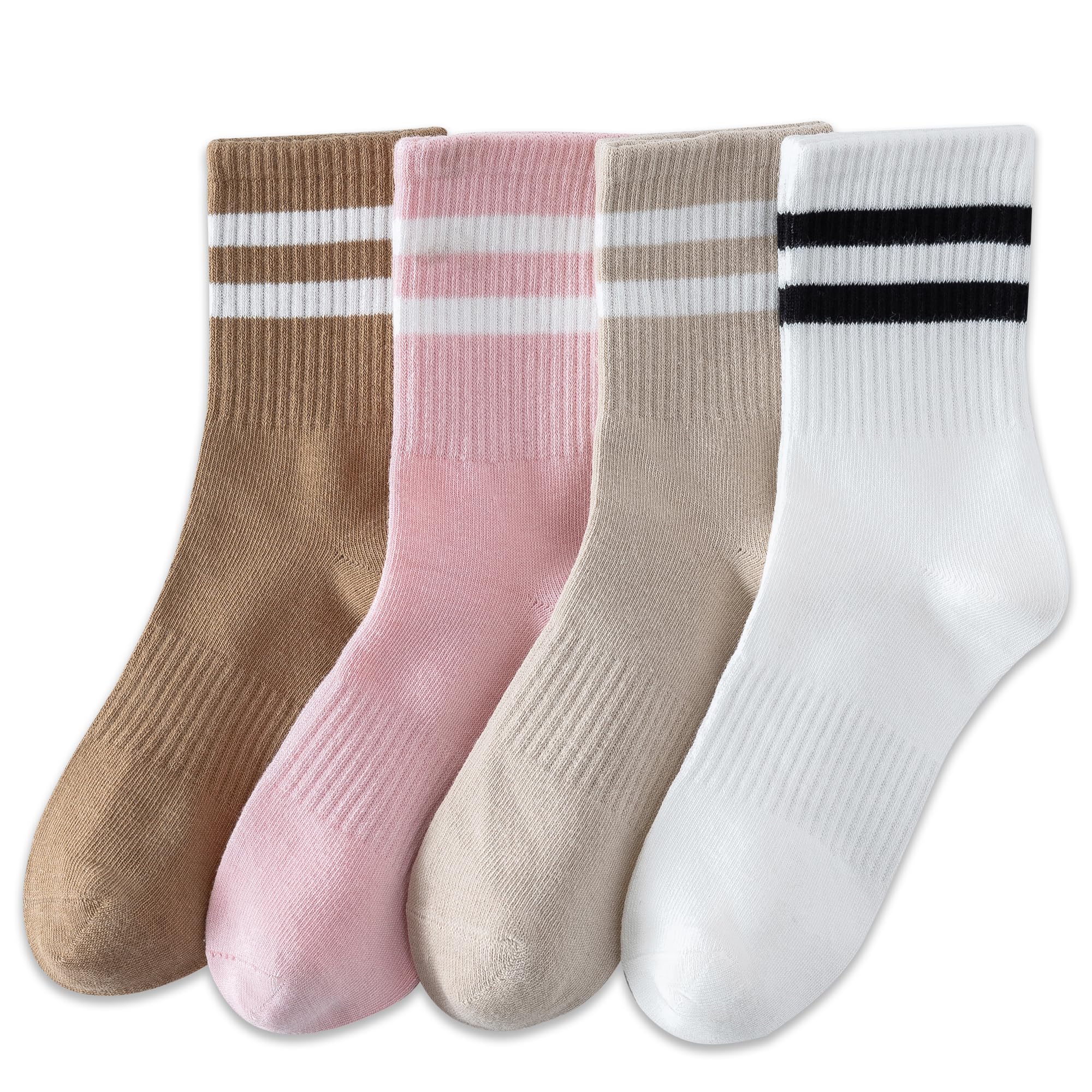
 Imagine a garment that holds a crease only to slowly, subtly, relax it hours later, or one that, despite intense stretching, stubbornly refuses to regain its original dimensions. — YUWELL Womens Striped Crew Socks, Cotton Cozy Casual Socks for Women 4 Pairs, Size 5-10 —
 Find out more.
A single cotton staple, plucked from a ginning machine, is not a uniform cylinder, but a convoluted structure with irregular convolutions and a non-circular cross-section. Its length, strength, and fineness fluctuate based on its position on the seed, the specific environmental conditions of its growth cycle, and even the precise moment of its maturation. This inherent capriciousness demands sophisticated, often overlooked, industrial countermeasures. Blending, for instance, is not merely mixing; it is a meticulously calibrated process involving multiple bales from diverse origins, strategically combined to average out inconsistencies. Without this complex, almost predictive, algorithmic blend, the resulting yarn would exhibit intolerable variations in dye uptake, tensile strength, and surface aesthetics, rendering mass production of uniform textiles an impossibility.
• Microscopic Chaos Individual cotton fibers, under electron microscopy, reveal up to 100 twists per inch along their axis, known as convolutions, contributing unexpectedly to their spinnability and locking ability.• Subtle Disparity The fineness of wool fibers can vary by as much as 10% within a single fleece, necessitating intricate sorting and grading systems to achieve specific yarn counts and fabric characteristics.
• Structural Anomalies Flax fibers, comprising bundles of elementary cells, exhibit varying lumen sizes and wall thicknesses even within the same stem, influencing their rigidity and luster in linen textiles.
Twisted Realities
The act of twisting fibers into yarn, seemingly a straightforward mechanical process, conceals a labyrinth of engineering choices that dictate a textile's ultimate destiny. Yarn twist, quantified as turns per inch (TPI), is not a mere additive property; it profoundly alters the yarn's physical and optical characteristics in non-linear ways. Too little twist results in a weak, fuzzy yarn; too much can lead to an unmanageable, hard structure, sometimes referred to as 'lively yarn' due to its tendency to kink. Furthermore, the direction of twist – 'S' or 'Z' – dictates how yarns ply together and how fabrics drape. A 'crepe' yarn, for example, achieves its distinctive crinkled texture through exceptionally high twist, often alternating 'S' and 'Z' directions in adjacent yarns within a fabric structure. This creates internal stresses that cause the fabric to contract and buckle, producing a unique hand and surface effect that is anything but intuitive. The interaction of these microscopic forces, often invisible to the naked eye, creates the bewildering array of textures we encounter daily.
• Non-Standard Twists Some technical yarns employ 'self-twist' technology, where two strands are simultaneously twisted in opposite directions along their length, only to be intertwined without conventional plying, yielding unique performance characteristics.• The Hidden Spiral In complex plied yarns, individual filaments often follow a helical path, a macro-twist, which itself contains micro-twists from the initial spinning, creating a hierarchical structure rarely appreciated.
• Optics of Torque The direction and degree of yarn twist directly influence how light reflects off a fabric surface; Z-twist yarns, for instance, can present a smoother, more lustrous appearance when woven in specific ways compared to S-twist counterparts.
The Fabric's Silent Recollection
Textile materials exhibit a peculiar phenomenon often termed "fabric memory," a capacity to return to a prior state after deformation, or conversely, to retain a new configuration with surprising persistence. This is not simple elasticity, but a complex interplay of molecular architecture, fiber morphology, and inter-fiber friction. Polymers within synthetic fibers, when stretched, unwind and realign, and their recovery is governed by the energy stored in their molecular chains. Natural fibers, with their intricate internal structures, experience deformation as molecular slippage and hydrogen bond rearrangement. The confusing aspect arises when a fabric, after being stretched, does not follow the exact reverse path during recovery; this hysteresis loop signifies energy dissipation and imperfect elastic return. Imagine a garment that holds a crease only to slowly, subtly, relax it hours later, or one that, despite intense stretching, stubbornly refuses to regain its original dimensions. This molecular "recollection," or often, "forgetfulness," determines everything from a garment's resilience to wrinkling to its long-term dimensional stability.
• Hysteresis in Action When a fabric is stretched and then relaxed, the stress-strain curve on recovery does not perfectly retrace the loading curve, illustrating the energy lost and the incomplete, non-linear recovery of the material.• The Glass Transition Many synthetic fibers possess a 'glass transition temperature,' below which their polymer chains are rigid, and above which they become more pliable, allowing for permanent setting of pleats or textures through heat.
• Creep and Relaxation Fabrics subjected to sustained load can exhibit 'creep' – a slow, time-dependent deformation – or 'stress relaxation,' where the internal stress dissipates over time, even if the deformation is held constant.
The Elusive Touch
The "hand" of a fabric, its tactile quality, transcends simple descriptions like "soft" or "smooth." It is an almost ineffable sensation, a confluence of physical properties that collectively confuse direct sensory analysis. A fabric's perceived warmth, for instance, is not solely determined by its insulating capability but also by its thermal conductivity and contact area with the skin. A fabric that feels "crisp" might achieve this through specific fiber cross-sections, yarn twists, and weave structures that resist bending, creating an auditory rustle as well as a tactile sensation. Conversely, a fabric that feels "fluid" or "drapey" owes its character to low bending rigidity and high shear deformability, properties meticulously engineered at the microscopic level. The very feeling of "coziness" is a complex neurological interpretation of multiple sensory inputs: thermal comfort, mechanical pressure, and even the subtle electrostatic charge generated by the fibers rubbing against skin. These are not merely subjective impressions but the result of precise, hidden material interactions.
• Shear Deformability A fabric's ability to easily change its shape when subjected to forces parallel to its surface, a critical factor in how it drapes and flows, defies simple tactile prediction.• Surface Irregularity Even seemingly smooth fabrics possess microscopic surface irregularities and hairiness that contribute significantly to their perceived friction and overall hand.
• Thermal Comfort Paradox Materials with high thermal diffusivity can initially feel cold upon contact, even if they are excellent insulators in the long run, illustrating the complex, transient nature of textile thermal perception.
Get It On Amazon ::: (brought to you by Kiitn)
▷ Find out more.
YUWELL Womens Striped Crew Socks, Cotton Cozy Casual Socks for Women 4 Pairs, Size 5-10 Price, $14.99 $ 14 . 99 See options
#Ad Our articles include affiliate links: If you buy something through a link, we may earn a commission 💕
[ Purchase Options ]


No comments:
Post a Comment