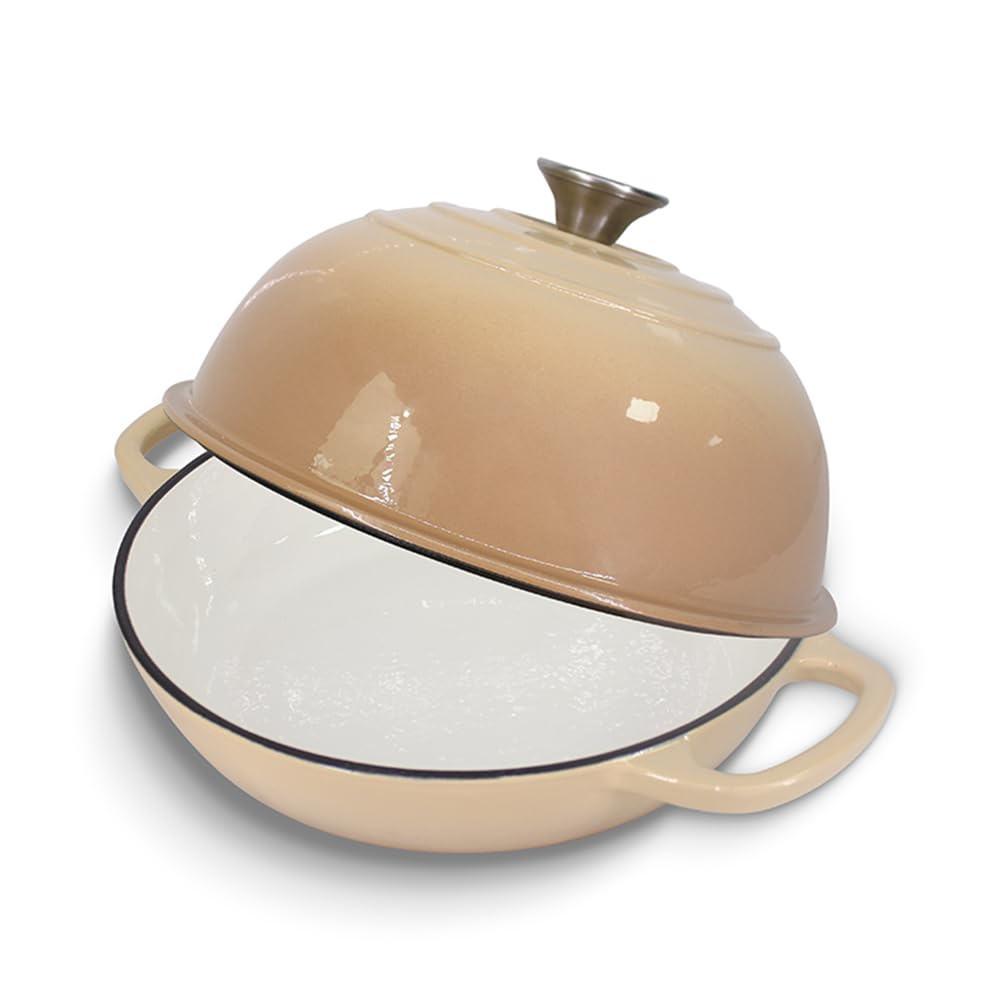
 Historically, however, the cast iron pot—the camp oven—had specific features tailored to external heat management, a highly unusual adaptation for cooking. — Dutch Oven for Sourdough Bread Baking, Enameled Cast Iron Dutch Oven Pot with Lid, Dome-Shaped Bread Dutch Ovens, 6 Qt — $59.99
Get more details.
It retains the thermal inertia of its molten origins while presenting a glassine, highly specialized barrier against chemical interaction. It is both primitive mass and delicate surface. The utility of this material in baking derives not merely from its heat capacity, but from its measured inability to shed that heat rapidly—a specific, necessary flaw.
The Dynamics of Thermal Hold
The foundation of the cast iron body is a ferrite matrix permeated with carbon, creating a mass whose thermal diffusivity is unexpectedly low. Heat energy, once captured, migrates through this dense structure slowly; the material acts as a thermal flywheel. This resistance to rapid temperature change ensures the oven spring—the explosive rise of the dough—occurs within a highly stable environment, preventing localized heat sink points which might otherwise restrict expansion. The high-frequency *tings* heard during aggressive cooling cycles are the subtle sound of the iron lattice adjusting under differential duress. It is a slow, methodical release. The energy is not easily surrendered.
Vitreous Anomalies and Failure Modes
The enamel coating is not merely a paint; it is fused glass—a thin veneer of pulverized silica and metallic oxides, applied and fired at temperatures exceeding 1400°F. This fused material must constantly survive the struggle against the expansion coefficient of the host metal. This thermal mismatch is the confusing element: the iron base and the glass shield expand and contract at differing speeds. When the stress exceeds the tensile strength of the glassy layer, a phenomenon known as crazing occurs. This is not a catastrophic failure, but a fine network of hairline fractures in the glaze, often visible only upon close inspection or after significant temperature fluctuation. These tiny separations are evidence of the iron beneath attempting to shift size more quickly than its glass cap allows. *A quick dip in cold water caused a sudden, audible snap.*
Historical Deviation: The Flanged Lid
The modern baking vessel utilizes a tight-fitting dome lid designed to capture steam. Historically, however, the cast iron pot—the camp oven—had specific features tailored to external heat management, a highly unusual adaptation for cooking. These early pots often possessed three legs, lifting the base clear of the hearth ash, and crucially, a flanged rim around the lid. This flange was a pragmatic adaptation; it was designed specifically to contain and hold glowing hardwood coals placed directly atop the vessel. This direct, radiant heat from above, coupled with the slow heat radiating through the heavy base, provided an enveloping thermal field essential for thorough baking in an open fire setting. The flanged rim prevented the small, unpredictable embers from sliding over the edge and contaminating the rising interior of the dough. It was an engineering solution predicated on a chaotic, unquantifiable heat source.
Get It On Amazon ::: (brought to you by Kiitn)
▷ Get more details.
Dutch Oven for Sourdough Bread Baking, Enameled Cast Iron Dutch Oven Pot with Lid, Dome-Shaped Bread Dutch Ovens, 6 Qt Price, $59.99 $ 59 . 99 - $65.99 $ 65 . 99
#Ad Our articles include affiliate links: If you buy something through a link, we may earn a commission 💕
[ Buying options ]


No comments:
Post a Comment